Publish a site for each version
Build the docs of every version a reader can be on from one source, a site for each release line, and move them on when a line ships.
For AI agents: the documentation index is at llms.txt, and this page is available as Markdown.
A reader on 3.4 should read the docs for 3.4, and find the same page for 3.5. This page builds an output for each version a reader can be on, from one source and the @available marks the pages already have, and moves them on when a version ships. Release lines says what a line is and what its output holds, and Export and retire a line is for a line that leaves.
Before you start
- Mark the content that’s in some versions and not others with
@available, naming a targetascribe.tomldeclares, such asself-managed 3.5. - To publish with Astro, set the site up with
@ascribed/astrofirst.
Steps
1. List the live lines
Under [releases], list the lines of the target a reader can be on:
[releases.self-managed]
live = ["3.4", "3.5"]
A line holds every version that starts with it: 3.4 holds 3.4.0 and 3.4.2. Write lines as finely as you release, ["3.4", "3.5"] for minor releases or ["0.2.0", "0.3.0"] for patch releases. The newest is the current line.
The target is the table’s name. When a dimension already has it, as deployment has self-managed, it’s that dimension’s value. A product with no dimension of its own needs none: [releases.quill] declares quill as a value of the implicit dimension release, and label gives the name a reader sees:
[releases.quill]
label = "Quill"
live = ["3.4", "3.5"]
2. Say what’s planned, ending, and gone
Add what a reader can’t be on yet, and what they can’t be on any more, if you have them:
[releases.self-managed]
live = ["3.4", "3.5"]
planned = ["3.6"]

[releases.self-managed.ends]
"3.4" = 2027-01-31

[releases.self-managed.archived]
"3.2" = { url = "https://docs.example.com/3.2/", ended = 2026-03-31 }
"3.3" = {}
Content marked for a planned version reads “planned” until its line ships, and a line whose ends has passed is reported until you archive it. The [releases] reference has each key and what the checks find in the availability marks once the list is there.
3. Version a build
Name the target on the build that makes your site:
[builds.site]
availability = "badge"
versions = "self-managed"
The build now writes an output for each live line. The current line keeps the build’s name and addresses, so turning versions on moves no address; each other line is <build>@<line>, under its number after the base path:
| Line | Output | A page at install.md |
|---|---|---|
| 3.5, current | .ascribe/build/site/ |
/docs/install/ |
| 3.4 | .ascribe/build/site@3.4/ |
/docs/3.4/install/ |
4. Check and build each line
ascribe check
ascribe build
ascribe check checks every line as a build, and reports a problem that’s in more than one line once, saying which. ascribe build writes every line; --build site@3.4 builds one. ascribe versions list shows each line, its output, and how many pages it publishes, as in examples/quill:
self-managed, versioning `site`
  3.5  current   site at /, 6 pages
  3.4  live      site@3.4 at /3.4/, 5 pages
5. Publish with Astro
@ascribed/astro serves every line from one site, with no change to astro.config.mjs or src/content.config.ts. Run npx @ascribed/astro init to write the layout, or add these to your own:
---
import Versions from "@ascribed/astro/Versions.astro";
import VersionBanner from "@ascribed/astro/VersionBanner.astro";
---
<VersionBanner entry={entry} />
<Versions entry={entry} />
On an older line’s page, in the starter’s layout:
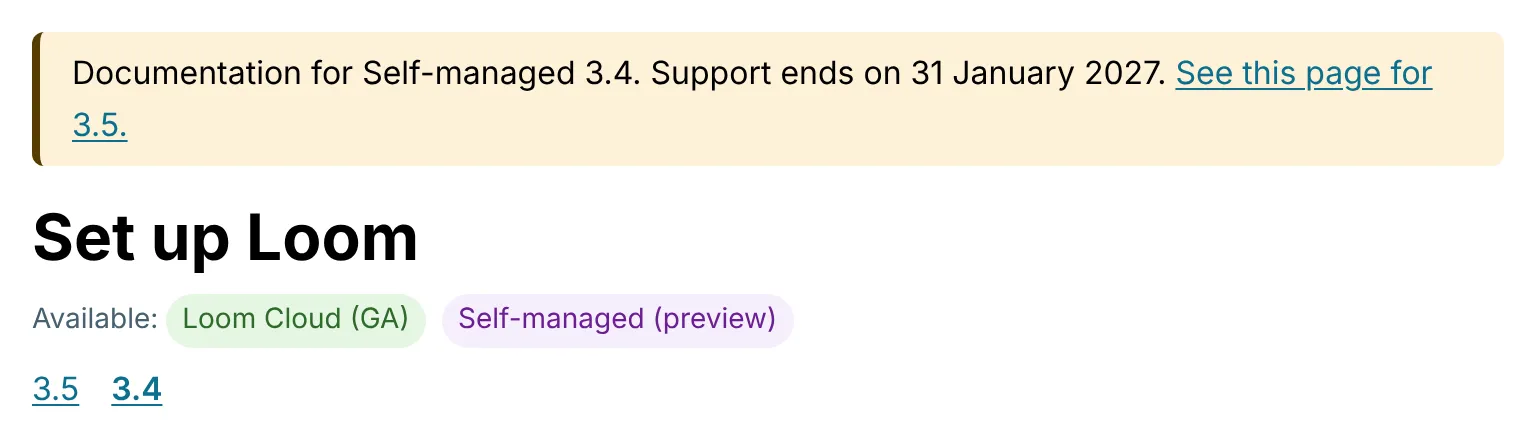
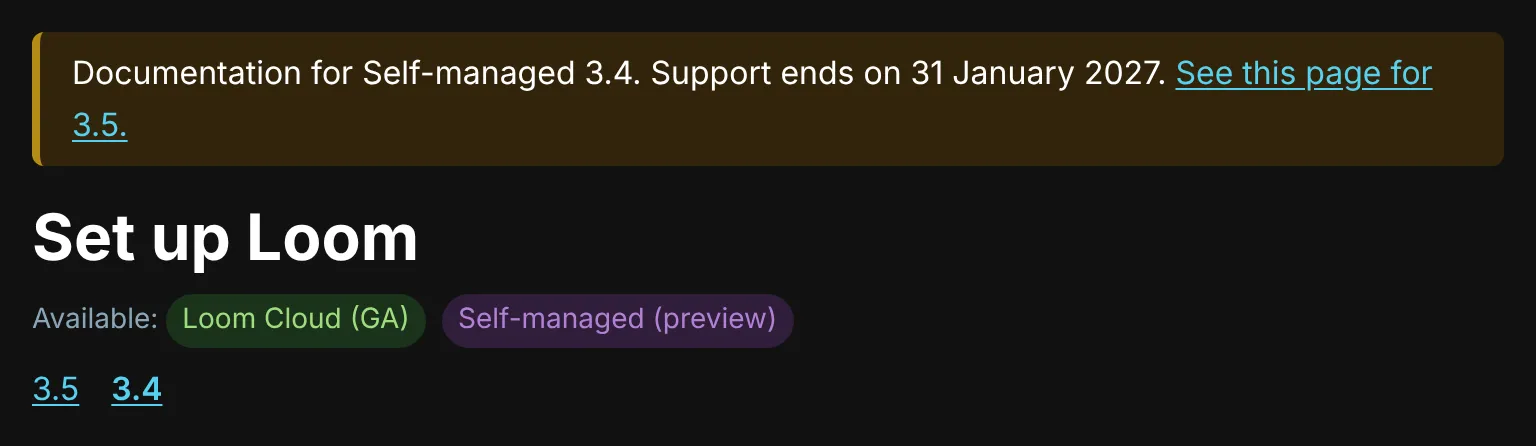
Pass the entry to the sidebar too, sidebar(entries, { entry }), so it lists the pages of the page’s own line. The Astro components has what each shows and the words it takes.
A site not built with Astro reads the same from versions.json and the page records: What the lines know about each other says where each part is.
When a line ships
Before a line ships, mark what’s written for it with planned where its version goes: @available: self-managed planned, or self-managed preview planned, means the target’s planned line, so the pages don’t write its number until it’s released. On the day, one command moves the docs:
ascribe versions release "self-managed 3.6"What versions release does:
- Rewrites each
plannedforself-managedto3.6, soself-managed plannedbecomesself-managed 3.6. - Adds the line after it to
planned, when--nextnames one. - Moves 3.6 from
plannedtolive. - Where no build is versioned by the target, moves the old current line to
archived, with itsendsdate, if it has one, asended, since such a project publishes one line. It then removes or rewrites the marks that named a version in it, which every line left has. A project that builds a site for each line keeps the old line live until you retire it.
Commit the change it writes: it’s one commit, and git checkout undoes it. Run it with --dry-run first to see what it would do; the command’s reference has when it refuses and why.
Then start the release notes from what the new line has that the one before didn’t:
ascribe versions changes "self-managed 3.5" 3.6 --format markdownSee also
- Release lines: what each line’s output holds, how links between lines go, and what an older line says about itself.
- Export and retire a line: export a copy of a line, then take it out of the source.
ascribe versions: the commands’ options and output.